
Choosing parts for Land Rover, Range Rover and Jaguar can look easier than it really is. It may seem that knowing the part name or finding a number on the old component is enough to place an order. In practice, that is not always sufficient.
The same part can differ by body code, model year, facelift, installation side or vehicle specification. Reliable identification usually uses several pieces of information together: VIN, OEM number, engineering number and fitment for the exact model.
1. Why the VIN matters
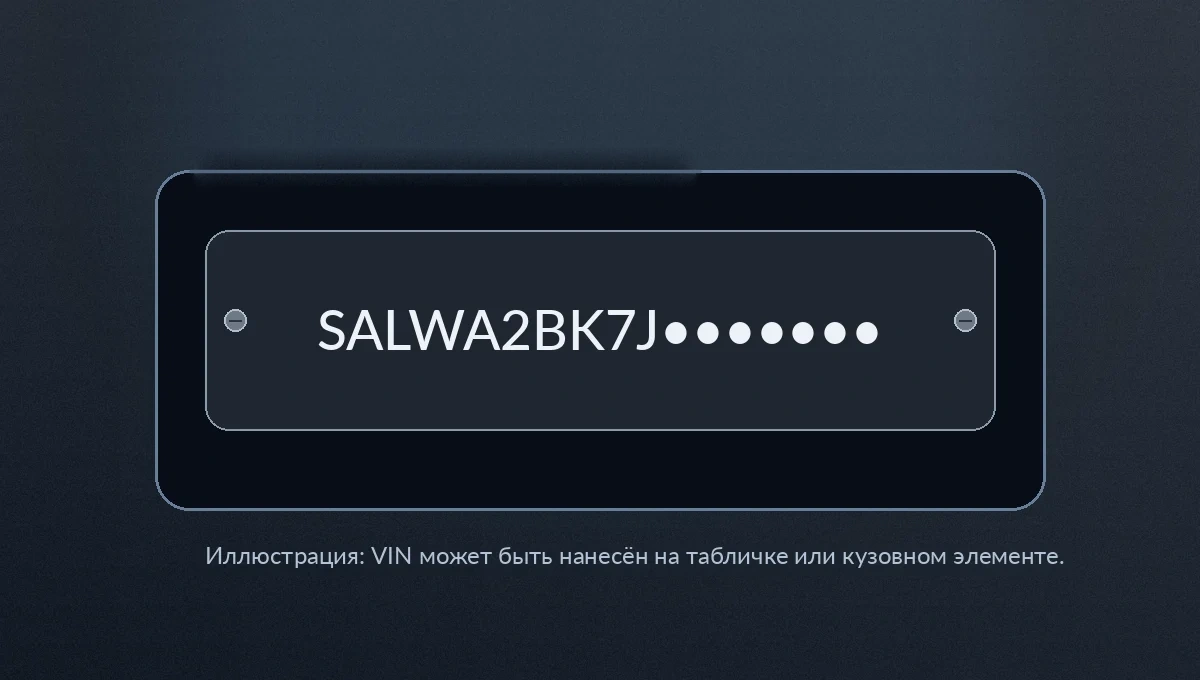
A VIN is a useful starting point when you need to identify the exact vehicle a part is being selected for.
It can help confirm the model, body code, model year, engine and part of the vehicle specification. This is especially useful for models that were produced for many years and received a facelift during their life cycle.
For example, simply saying “Range Rover Sport L494” is not always enough. Some parts fit the whole production run, while others apply only to certain years or to the facelift version.
A VIN narrows the search considerably, but it does not always lead to one single part number. Sometimes the catalogue shows several options. In those cases, the number from the old part, a photo and the installation side can help.
You can browse parts in the Land Rover and Range Rover catalogue.
2. What is an OEM number and why can it change?
An OEM number is the catalogue number normally used to find a part in catalogues and stores. Land Rover and Jaguar parts often use service numbers beginning with LR..., J9C... and other JLR formats.
If the exact OEM number is known, the search becomes much easier: availability, price, fitment and possible supersessions can all be checked.
However, an old OEM number does not necessarily remain current forever. The manufacturer may replace it with a newer number after a design change, supplier change or catalogue update.
So if an old OEM number is difficult to find, it does not automatically mean that the part is no longer available. It may simply be sold under a newer number.
3. OEM number vs engineering number: what is the difference?
This is one of the most important points when identifying JLR parts.
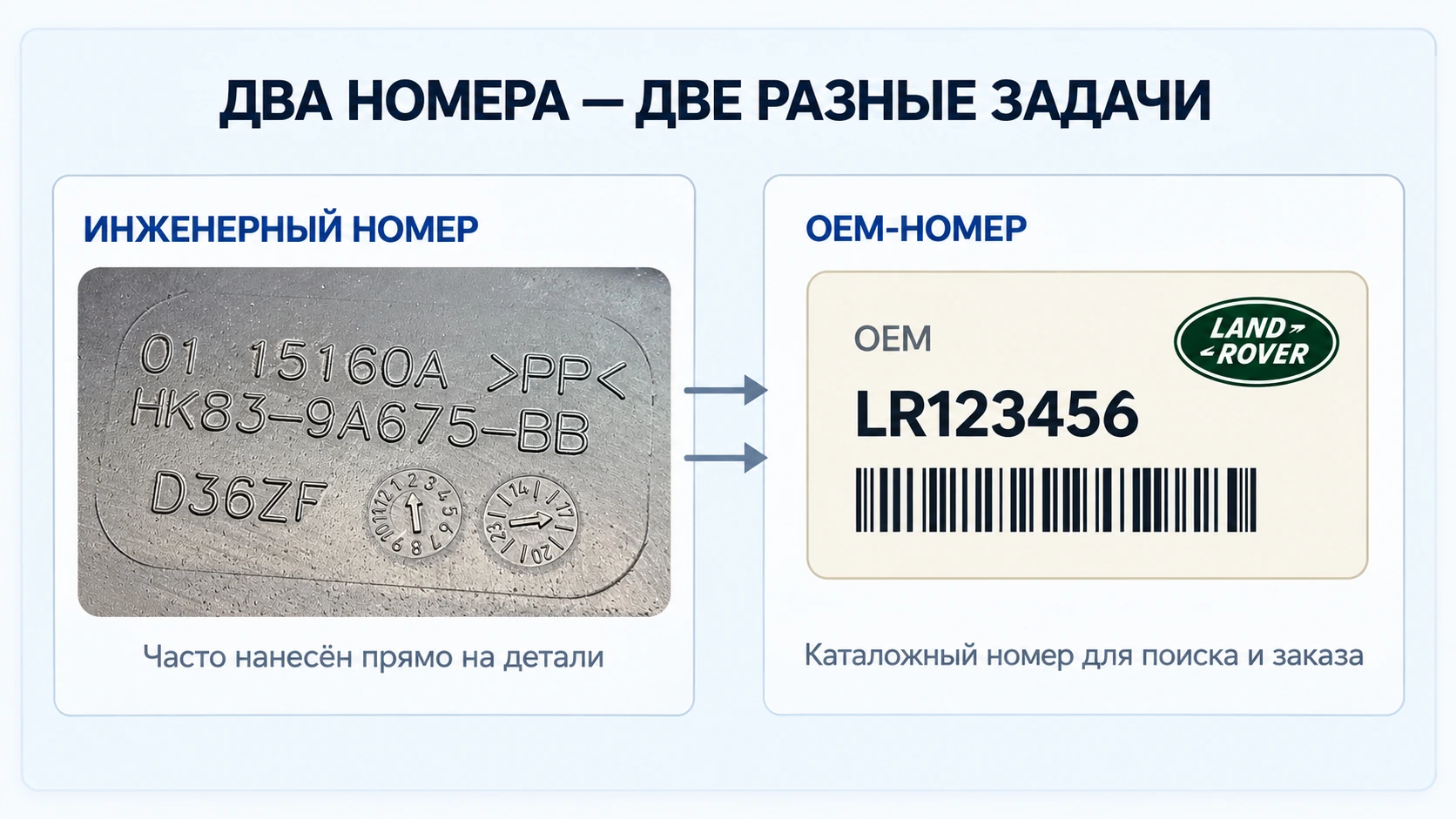
OEM number — the number under which the part appears in the parts catalogue and is normally ordered.
Engineering number — a marking often found directly on the physical component: moulded into plastic, stamped into metal, printed on a module housing, bracket or label.
This is why a common situation occurs: there is a clear number on the old part, but searching normal parts stores returns little or nothing. That does not mean the number is wrong. It may be an engineering number that needs to be linked to the relevant OEM catalogue number.
4. Why model years and facelifts matter
Parts can change during the production run even within the same body code.
2013–2022
facelift 2018–2022
This can make a major difference to fitment. At the same time, it is wrong to assume that every part first used before the facelift fits only early vehicles. Some components continue unchanged after the model update.
The safest approach is to check the actual fitment of the specific part number rather than relying only on labels such as “pre-facelift”.
5. Installation side and position
Even with the correct number, simple details can still cause mistakes. Many components have separate left- and right-hand versions, front and rear positions, or several similar variants within the same assembly.
This is especially common with brackets, plastic trim, body parts, suspension components and lighting. A description such as “bumper bracket” or “headlamp bracket” by itself is not enough to confirm fitment.
6. What helps with accurate part identification
- Vehicle VIN
- the number from the old part, if available
- a photo of the part
- installation side — left or right
- front or rear position
- if known — model, body code and model year
The more information is available at the start, the lower the chance of selecting a similar-looking but incorrect part.
What the check looks like in practice
- Identify whether the number is an OEM number or an engineering number.
- If it is an engineering number, find the related OEM number.
- Check whether the OEM number has been superseded by a newer one.
- Check fitment for the correct model and body code.
- Check model years and facelift applicability.
- Confirm the installation side and position.
- If necessary, verify everything against the VIN.
A photo is useful too, but relying on appearance alone is risky. Two parts can look almost identical while differing in length, shape, hole position or mounting point.
7. How LandMotion approaches part identification
We try not to confirm fitment from the part name alone. Where possible, we check several details together: VIN, OEM number, engineering number, supersessions, body code, model years, facelift and installation side.
If there is not enough information, it is better to ask for additional details than to confirm a part blindly.
Frequently asked questions
Can a part be identified using only the VIN?
Sometimes, but not always. For some parts the catalogue may show several variants. The number from the old component and a photo can then provide the extra information needed.
If the number on the part does not begin with LR, is it wrong?
No. It may be an engineering number or a component manufacturer's number. It needs to be checked and linked to the relevant catalogue number.
What if the old OEM number can no longer be found?
Check whether it has been officially superseded by a newer part number.
Which is more important: VIN or OEM number?
They serve different purposes. The OEM number identifies the part, while the VIN helps verify whether that part applies to the specific vehicle. Using both is best.
Key points
For accurate Land Rover, Range Rover and Jaguar part identification, it is better not to rely on a single piece of information. A reliable check combines VIN, OEM number, engineering number, supersessions, body code, model years, facelift and installation side.
If all you have is the number from the old part, that is still a good place to start. If you also have the VIN and a photo, even better.